 WhatsApp
 Call
Call
Bunched Copper Wire Manufacturer in India
When an electrical system needs a conductor that combines high electrical conductivity with flexibility, the construction of the wire becomes just as important as the material itself. This is where bunched copper wire becomes an important solution for manufacturers, electrical engineers, equipment builders and industrial buyers. Instead of relying on one large solid conductor, bunching brings multiple fine copper wires together to create a practical conductor that can bend, move and fit into demanding assemblies. For companies searching for a dependable Bunched Copper Wire Manufacturer in India, Ganpati Wire offers a product portfolio built around copper conductors, flexible wires, stranded wires, braided products and connector solutions. Current product information from Ganpati Wires identifies bare bunched copper wire among its core offerings and states that the company works with high-purity copper while maintaining ISO 9001:2015 and RoHS-related certifications. The wider Indian market also shows bunched copper wire being supplied for electrical and industrial uses, with manufacturers offering different sizes, constructions and customized specifications. For an industrial buyer, that means the right manufacturer is not simply the company offering copper wire; it is the company capable of delivering consistent conductor construction, suitable flexibility, reliable electrical performance and specifications aligned with the final application.
Understanding Bunched Copper Wire
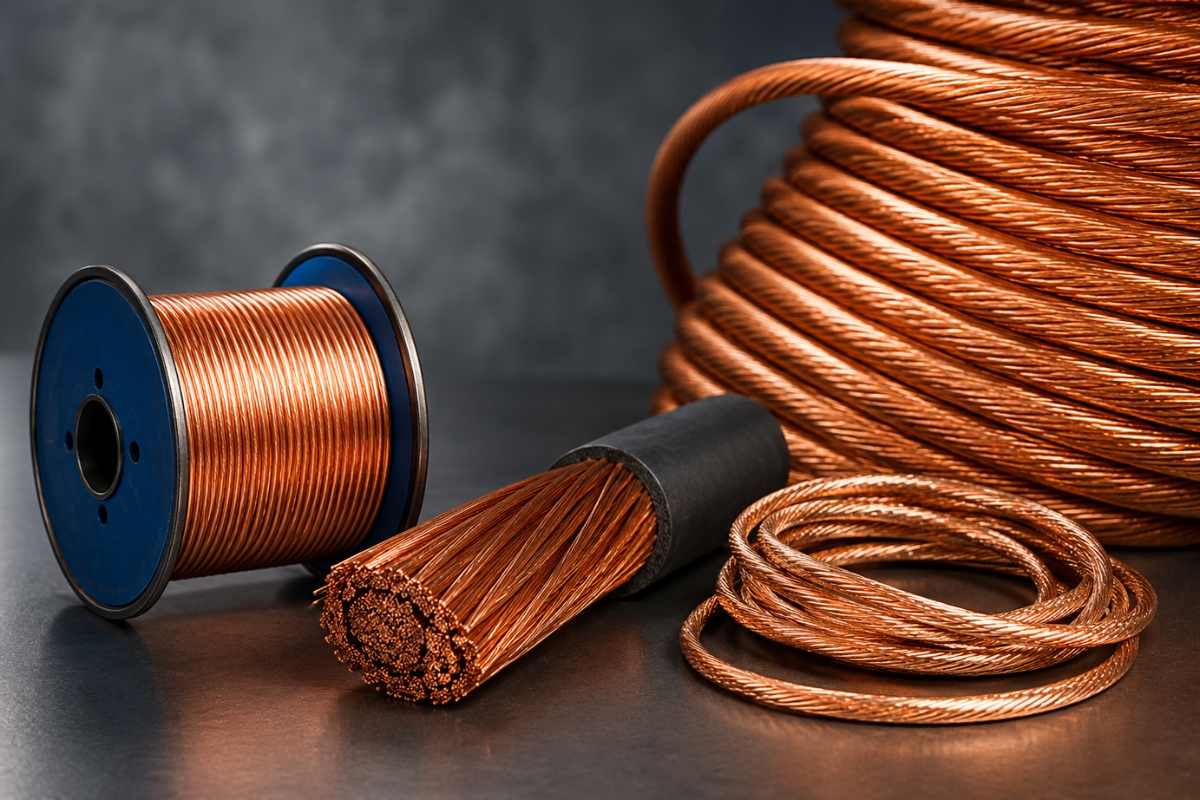
Bunched copper wire is produced by bringing together multiple individual copper wires or filaments into a unified conductor arrangement. The individual elements work collectively, allowing the finished conductor to offer characteristics that a single solid copper wire cannot provide in the same way. Depending on the required application, the number, diameter, arrangement and condition of the individual copper elements can influence flexibility, handling, electrical characteristics and mechanical behaviour. This makes bunching particularly useful when a conductor must pass through equipment, accommodate movement, or be integrated into assemblies where a rigid conductor would be inconvenient. Ganpati Wires lists bare bunched copper wire as part of its product range alongside braided flexible copper wire, stranded copper wire, tinsel wire and several flexible connector products. In practical terms, the concept is quite simple: instead of asking one conductor to do everything, multiple smaller conductors work together as one electrical path. Think of it like a bundle of thin branches compared with a single thick branch; the bundle can provide a different combination of movement, handling and structural behaviour. For industrial applications, that flexibility can make installation, routing and assembly considerably easier.
The terms bunched, stranded and solid copper wire are sometimes used interchangeably in casual conversations, but they describe different conductor constructions and manufacturing approaches. A solid conductor is essentially one continuous metal element, while stranded copper wire consists of multiple individual strands arranged together, commonly with a defined stranding pattern. Ganpati Wires describes stranded copper wire as multiple thin copper filaments twisted or bundled together, with the construction providing greater flexibility than a solid conductor. Bunched conductors, on the other hand, are generally associated with individual wires brought together in a bunching process rather than necessarily following the same regular geometric arrangement expected from a conventional stranded conductor. The distinction matters because industrial customers often select wire based not only on cross-sectional area but also on how the conductor behaves during bending, termination and assembly. A manufacturer with experience across both bunched and stranded constructions can therefore help customers identify the most suitable option instead of treating every flexible copper requirement as the same product.
Why Copper Is Preferred for Bunched Wire
Copper has remained a preferred conductor material because it combines excellent electrical conductivity with useful mechanical characteristics and established manufacturing technology. When copper is converted into multiple fine elements and then bunched, manufacturers can take advantage of copper's conductivity while improving the conductor's practical flexibility. Ganpati Wires states that it manufactures copper products using high-purity EC Grade copper, with its current website highlighting 99.90% copper purity. The company's product information for stranded copper wire also describes low DC electrical resistivity values for its copper constructions, demonstrating the importance it places on conductor quality and electrical performance. For an equipment manufacturer, these properties are not merely technical specifications on a datasheet. They can influence current-carrying performance, heat generation, connection reliability and the overall behaviour of an electrical assembly. Copper also has excellent workability, which makes it suitable for drawing into fine wires before those wires are brought together into bunched constructions. That combination of electrical and manufacturing characteristics explains why copper remains a central material for flexible electrical conductors across industrial applications.
A good bunched copper conductor needs to achieve a practical balance rather than maximizing one characteristic at the expense of everything else. Extremely fine elements can improve flexibility, but the conductor still needs sufficient mechanical integrity for handling, installation and termination. Similarly, a larger conductor may provide the required electrical capacity while becoming less convenient in applications involving repeated bending or restricted installation spaces. This is why industrial wire selection should begin with the application's actual requirements rather than simply choosing the largest or smallest available wire. Bunched construction can help distribute bending across multiple individual copper elements, making the conductor more accommodating in applications where movement or routing is involved. Ganpati Wires' wider product portfolio includes bunched, stranded, braided and high-flexible copper constructions, indicating that different mechanical requirements can be addressed through different conductor designs. The right combination ultimately depends on conductor size, flexibility requirement, operating environment, termination method and electrical load. For buyers, discussing these factors with a technically capable Bunched Copper Wire Manufacturer can prevent costly mismatches between the selected conductor and the finished equipment.
How Bunched Copper Wire Is Manufactured
The manufacturing journey of a quality bunched copper wire begins long before the final conductor reaches a customer's production line. Copper rod is processed through drawing operations to achieve the required wire diameter, with controlled manufacturing conditions helping produce consistent individual elements. Depending on the product design, annealing may be used to obtain the desired softness and flexibility before the wires enter the bunching stage. During bunching, multiple individual copper wires are brought together into the specified configuration to create the final conductor. Each stage can affect the finished product, which is why manufacturing consistency is essential. Ganpati Wires describes its broader manufacturing capabilities as including bare bunched and braided copper wire solutions and a portfolio spanning multiple copper and tin-coated constructions. The process can be compared with building a strong rope: the performance of the finished rope depends not just on the material but on the quality, consistency and arrangement of the individual fibres. In the same way, the performance of bunched copper wire depends on the quality of its copper elements and the precision with which those elements are brought together.
Drawing, Annealing and Bunching Processes
Wire drawing reduces the diameter of copper rod through controlled dies, allowing manufacturers to produce fine conductor elements suitable for different electrical requirements. Annealing can then influence the mechanical condition of the copper, particularly when a softer and more flexible conductor is required. Once the individual wires are prepared, bunching equipment combines them into the required conductor structure. Consistency during this stage matters because variations in tension, alignment or bunching characteristics can affect the finished wire's appearance, flexibility and electrical behaviour. Industrial buyers should therefore consider the manufacturer's process capability rather than looking only at the final price per kilogram. A low-cost wire that produces inconsistent results on a production line can become more expensive through rejected assemblies, difficult termination or unnecessary downtime. Ganpati Wires' established product range includes multiple copper conductor constructions, including bare bunched wire, stranded wire, braided flexible wire and laminated flexible connectors. That breadth can be valuable when a buyer needs to move between different conductor designs while maintaining a relationship with a specialized copper-wire manufacturer.
Quality Control in Bunched Copper Wire Manufacturing
Quality control is one of the most important factors when selecting a Bunched Copper Wire Manufacturer in India because electrical conductors are often installed inside equipment where inspection and replacement are difficult. A quality program should consider the copper material, wire dimensions, conductor construction, surface condition, electrical properties and consistency between production batches. Even a small variation can matter when a wire is being used in a precision electrical assembly or produced in large volumes. Ganpati Wires identifies itself as ISO 9001:2015 certified and RoHS certified on its current corporate website, while its product information emphasizes controlled copper quality and electrical performance. Buyers should still specify their own technical requirements clearly, including conductor size, copper grade, construction, flexibility, coating requirements and packaging. A strong manufacturer should be able to discuss these parameters and explain how they are controlled during production. In other words, quality should not be treated as a final inspection activity; it should be built into the manufacturing process from raw material selection through finished-wire testing.
Key Features of Ganpati Wire Bunched Copper Wire
Ganpati Wire's product portfolio is positioned around copper conductors designed for industrial and electrical applications, with bare bunched copper wire included among its listed products. The company's website highlights more than four decades of experience, 99.90% copper purity and a broad product portfolio covering bare, tinned, stranded, braided and flexible copper constructions. These details are particularly relevant for buyers who need more than a generic copper wire supplier. A manufacturer that understands different conductor constructions can evaluate whether a bunched wire, stranded wire, braided connector or another flexible copper product is more appropriate for a particular application. Ganpati Wires also lists products such as tinsel copper, silver and tin wire, earthing wires, laminated flexible connectors, high-flexible wires and copper strips, demonstrating the breadth of its copper-focused manufacturing portfolio. For procurement teams, this can simplify sourcing because multiple related conductor requirements may be discussed with one specialized manufacturer rather than being divided among several suppliers.
Applications of Bunched Copper Wire
Bunched copper wire can be used across applications where electrical conductivity and manageable flexibility are important. Depending on its construction and specification, it can be incorporated into electrical equipment, cable assemblies, industrial machinery, control systems, automotive components and other electrical products. The Indian market currently shows bunched copper wire being offered for electrical and industrial uses, including customized lengths and different sizes. Ganpati Wires' own portfolio demonstrates the broader role of flexible copper Copper purity has a direct relationship with the electrical performance expected from a conductor, which is why it should be treated as a core purchasing specification rather than a marketing phrase. Ganpati Wires currently states 99.90% copper purity for its products and identifies EC Grade copper in its product information. Electrical buyers should also consider resistivity, conductor cross-sectional area, temperature conditions and the actual operating current when evaluating a wire. A conductor that looks suitable by diameter alone may not perform identically if its material grade, construction or manufacturing quality differs. For high-volume industrial production, consistency is equally important because a manufacturer may need to supply the same specification repeatedly across multiple batches. This is where documented specifications and quality-control procedures become valuable. Ganpati Wires' stranded copper product information, for example, provides specific resistivity figures for bare and tin-coated constructions, illustrating the type of electrical parameter that should be evaluated alongside mechanical properties. A professional buyer should therefore assess both material quality and finished-conductor performance before approving a wire for production.conductors, listing applications across industrial products and multiple conductor types. The exact application should always determine the wire specification; a conductor intended for static installation may require a different construction from one exposed to continuous movement. Temperature, current, vibration, installation space and termination requirements should all be considered before selection. This is why the term “bunched copper wire” should be viewed as the beginning of a technical conversation rather than the complete specification.
Electrical and Industrial Applications
In electrical and industrial environments, bunched copper wire can be useful wherever a conductor needs to combine conductivity with improved handling characteristics. Equipment manufacturers may use flexible copper conductors in internal connections, electrical assemblies, control equipment and other systems where rigid conductors would make routing more difficult. Industrial machinery can also involve vibration and movement, creating a need for conductors that tolerate mechanical conditions more effectively. The suitability of a specific bunched wire depends on the conductor size, number and diameter of individual wires, material condition and whether the wire is bare or coated. Ganpati Wires' product portfolio includes bare bunched copper, braided flexible copper, stranded copper, tinned copper and flexible connectors, giving industrial customers several construction options. For procurement teams, this means application-based selection is more useful than selecting wire solely according to a general product name. A knowledgeable manufacturer can help match conductor construction to the electrical, mechanical and environmental demands of the equipment.
Bunched Copper Wire for Flexible Electrical Connections
Flexibility is often the reason an engineer chooses a multi-element copper conductor instead of a rigid solid conductor. In a machine, panel, electrical assembly or equipment enclosure, wires may need to turn around corners, pass through limited spaces or accommodate small movements during operation. A bunched construction allows the conductor to behave differently from a single solid copper element, making it easier to route and handle. However, flexibility is not determined by the word “bunched” alone; the diameter of the individual elements, their condition, overall conductor size and construction all matter. Ganpati Wires also offers stranded and high-flexible copper constructions, which demonstrates that the company approaches flexibility through different conductor technologies rather than treating every application identically. If an application involves repeated flexing, buyers should specifically discuss flex-life requirements with the manufacturer instead of assuming that any flexible-looking copper wire will deliver the same performance. The correct conductor is the one designed around the movement profile and electrical requirements of the finished product.
Bare Bunched Copper Wire vs Tin-Coated Bunched Copper Wire
Bare copper and tin-coated copper are both useful, but they serve different environmental and application requirements. Bare copper offers the inherent conductivity and workability associated with copper and is often suitable for general electrical applications where additional surface protection is not necessary. Tin-coated copper adds a protective tin layer over the copper, which can improve resistance to environmental degradation and provide useful solderability characteristics. Ganpati Wires' current product information describes tin-coated copper wire as a copper conductor with a thin tin layer and highlights applications such as marine wiring, automotive harnesses, solar panels, transformers and industrial equipment exposed to demanding conditions. The choice therefore depends on the environment, connection method and required service characteristics. A buyer should not automatically assume that tin coating is better for every application; it may add cost and should be selected when its benefits are relevant. The best Bunched Copper Wire Manufacturer should be able to offer both options or recommend an appropriate alternative based on the customer's actual operating conditions.
Choosing the Right Bunched Copper Wire Manufacturer
Selecting a manufacturer is a strategic purchasing decision because conductor quality can influence the reliability of the final electrical product. Start by examining the manufacturer's copper quality, manufacturing experience, product range, quality systems and ability to provide consistent specifications. It is also useful to determine whether the manufacturer produces related products such as stranded, braided, tinned and flexible connectors because this can indicate deeper expertise in conductor technology. Ganpati Wires' current portfolio covers a broad range of copper wire and flexible connector products, while its website states that the business was established in 1977 and is ISO 9001:2015 certified. Buyers should request technical documentation and confirm dimensions, construction, copper grade, electrical characteristics and packaging before placing large orders. Price should be evaluated, but it should not become the only selection criterion. In industrial purchasing, a slightly lower purchase price can quickly lose its advantage if inconsistent wire creates production problems, rejected assemblies or delivery delays.
What Industrial Buyers Should Check
Before finalizing a Bunched Copper Wire Supplier, buyers should look beyond a product photograph or general catalogue description. The most useful evaluation starts with the actual technical requirements of the application, followed by confirmation that the manufacturer can consistently produce them. Important parameters may include conductor material, copper purity, wire diameter, total cross-sectional area, number of elements, bunch construction, flexibility, surface finish, coil or spool length and packaging. Environmental requirements such as humidity, temperature, chemical exposure and vibration may also influence whether bare or coated copper is appropriate. Buyers should additionally ask about quality certifications, batch traceability and testing procedures where these are relevant to their industry. Ganpati Wires' product information provides technical details for its copper products and identifies ISO 9001:2015 and RoHS credentials at the company level. A clear specification sheet protects both buyer and manufacturer because it removes ambiguity and creates a measurable reference for production and inspection.
Custom Bunched Copper Wire Solutions
Industrial applications rarely fit perfectly into one generic product size. A machinery manufacturer may need a specific conductor diameter, a cable assembler may require a particular bunch construction, while an electrical equipment producer may need consistent coil lengths for automated production. Customization can therefore become an important capability when purchasing bunched copper wire in commercial quantities. Ganpati Wires' broader portfolio includes multiple copper conductor types and flexible products, and market listings for bunched copper wire also show manufacturers supplying customized sizes and lengths. Customization should begin with a technical discussion rather than a simple request for “custom wire.” The buyer should provide the intended application, electrical load, mechanical conditions, preferred dimensions, required flexibility and any coating or compliance requirements. A capable manufacturer can then determine whether the requested specification is technically and commercially practical. This approach reduces trial-and-error and helps the finished conductor integrate smoothly into the customer's production process.
Bunched Copper Wire for Automotive and Electronics
Automotive and electronic systems often place unusual demands on electrical conductors because space can be limited and assemblies may experience vibration, movement and repeated handling. Flexible copper conductors can make routing easier and help manufacturers build compact electrical assemblies. Tin-coated copper can be particularly useful in environments where corrosion resistance and solderability are important, and Ganpati Wires identifies automotive harnesses among applications for its tin-coated copper products. For electronic applications, conductor dimensions and flexibility may need to be controlled carefully because the wire must fit into small assemblies without creating unnecessary mechanical stress. The final selection should also account for insulation, termination and operating temperature where applicable. Bunched copper wire can be a practical option when multiple fine copper elements provide the desired combination of electrical performance and handling characteristics. The important point is that automotive and electronics buyers should specify the complete operating environment rather than selecting wire based on conductor material alone.
Bunched Copper Wire for Transformers and Electrical Equipment
Transformers and electrical equipment depend on conductors that can reliably carry current while fitting within carefully engineered spaces. Copper is widely used in electrical equipment because of its strong conductivity, while flexible conductor constructions can help with routing and connection requirements. Ganpati Wires' product range includes copper wire, stranded and braided products, laminated flexible connectors and other conductor solutions suitable for different electrical applications. Its tin-coated copper product information also lists transformers among potential applications where enhanced surface protection can be beneficial. For transformer and equipment manufacturers, wire selection should account for current, temperature rise, connection design, insulation system and mechanical conditions. Bunched construction can be valuable when flexibility is needed, but it should be evaluated against the specific design requirements. Working directly with an experienced manufacturer can help engineering teams select an appropriate conductor construction and avoid unnecessary changes after production has begun.
Role of Flexibility in Wire Performance
Flexibility is not simply about whether a wire can bend by hand. In an industrial context, flexibility refers to how a conductor behaves under a particular bending radius, installation condition or movement cycle. A wire may be easy to bend during installation but unsuitable for repeated dynamic movement, which is why application conditions matter. Bunched and stranded constructions can provide improved handling compared with solid conductors, but the actual performance depends on the design of the individual elements and overall conductor. Ganpati Wires distinguishes among bare bunched, stranded, braided and high-flexible products in its portfolio, showing that these constructions are intended to address different requirements. Engineers should therefore communicate whether flexibility is required only during installation or throughout the product's service life. Once that distinction is clear, the manufacturer can recommend a construction that better matches the application's mechanical demands.
Why Manufacturing Precision Matters
Manufacturing precision is what turns a copper raw material into a dependable industrial conductor. When multiple fine wires are combined, consistency in individual wire dimensions and bunching conditions can influence the finished conductor's uniformity. Variations may affect handling, termination, resistance and the repeatability of production batches. This becomes particularly important when the customer is manufacturing thousands of electrical assemblies where even a small inconsistency can become a recurring production issue. A professional manufacturer should therefore operate with controlled processes, documented specifications and appropriate quality checks. Ganpati Wires identifies ISO 9001:2015 certification and a long-standing manufacturing history on its current website, while its product pages provide technical information around copper purity and electrical characteristics. For buyers, these indicators should be combined with application-specific testing and sample approval before a large production order. Precision is ultimately about predictability: every batch should behave as closely as possible to the specification agreed with the customer.
Advantages of Buying Directly from a Manufacturer
Purchasing directly from a Bunched Copper Wire Manufacturer can offer several practical advantages over buying through an intermediary. The most obvious is technical communication: engineers can discuss the product specification directly with the people responsible for manufacturing rather than relying on multiple layers of interpretation. Direct manufacturer relationships can also make customization, sample development, quality discussions and recurring orders easier to manage. Ganpati Wires operates a broad copper product portfolio, including bunched, stranded, braided, tinned and flexible copper solutions, making it possible to discuss related conductor requirements within one manufacturing ecosystem. Direct procurement can also improve visibility into product specifications and manufacturing capabilities. For large-volume buyers, establishing a direct relationship may help with production planning and repeat-order consistency. The best approach, however, is to evaluate the manufacturer based on technical competence, quality, service and delivery reliability rather than assuming that direct purchasing automatically guarantees better results.
Why Ganpati Wire Is a Trusted Copper Wire Brand
Ganpati Wire stands out as a specialist copper-wire brand with a broad range of conductor and flexible connection products. Its current corporate information states that the company was established in 1977, has more than 47 years of experience, highlights 99.90% copper purity, and identifies ISO 9001:2015 and RoHS certification. Its product portfolio includes bare bunched copper wire, bare and tin-coated copper wire, braided flexible copper, stranded copper, tinsel wire, laminated flexible connectors, high-flexible copper and other copper products. This breadth is useful for customers whose product requirements evolve from a simple copper wire into a more specialized flexible conductor or connector. Ganpati Wires' product information also demonstrates attention to technical characteristics such as copper purity, electrical resistivity and application suitability. For an industrial buyer, a trusted brand is ultimately one that combines material quality, manufacturing consistency, technical understanding and dependable supply.
Bunched Copper Wire Manufacturer in India for Bulk Requirements
Bulk procurement requires a different mindset from buying a small quantity for a one-time project. Production planning, batch consistency, packaging, delivery schedules and repeat specifications become critical because the wire becomes part of a larger manufacturing workflow. A dependable Bunched Copper Wire Manufacturer in India should therefore be capable of supporting both the initial technical approval and subsequent repeat orders. Ganpati Wires' established product range and manufacturing history provide a foundation for customers looking for ongoing copper-wire supply. Indian market listings also show demand for bunched copper wires in industrial applications and different customizable sizes and lengths. Before committing to a bulk order, buyers should finalize the technical specification, sample approval, packaging method, quantity, delivery schedule, and inspection expectations. Once these details are documented, the purchasing relationship becomes much more predictable. For manufacturers, that predictability can be as valuable as the copper itself because consistent material supply helps keep production lines moving.
Conclusion
Choosing the right Bunched Copper Wire Manufacturer in India is about much more than finding a supplier with copper wire in its catalogue. The finished conductor must match the electrical, mechanical and environmental requirements of the application, while the manufacturer must be capable of delivering consistent quality from one batch to the next. Bunched construction can provide a practical balance of conductivity and flexibility, making it valuable for electrical assemblies, industrial equipment, automotive applications, electronics and other demanding systems. Ganpati Wire brings decades of copper-wire manufacturing experience, a broad range of conductor technologies and a product portfolio that includes bare bunched copper wire, stranded and braided conductors, tin-coated wires and flexible connector solutions. Its published product information also emphasizes copper purity and electrical performance, while the company identifies ISO 9001:2015 and RoHS certification. For businesses seeking a dependable Bunched Copper Wire Manufacturer, Ganpati Wire can be positioned as a specialist partner focused on copper conductor quality, application-specific solutions and long-term industrial requirements.
Frequently Asked Questions
Bunched copper wire is a conductor made by bringing multiple individual copper wires or fine copper elements together into a unified conductor. The construction can provide useful flexibility and handling characteristics while retaining copper's strong electrical conductivity. It is used in applications where a solid conductor may be too rigid or inconvenient. The exact performance depends on the individual wire dimensions, number of elements, copper quality and bunching construction. Ganpati Wires lists bare bunched copper wire among its main copper conductor products.
Bunched and stranded copper wires both use multiple copper elements, but their construction and arrangement can differ. Stranded wire is generally manufactured with a defined arrangement or twisting pattern, while bunched wire brings individual elements together in a bunching process. The distinction can influence flexibility, geometry and application suitability. Ganpati Wires separately lists bunched, stranded and braided copper products, reflecting the different conductor constructions available for industrial requirements.
The most important considerations include copper grade and purity, conductor size, individual wire dimensions, bunch construction, flexibility, electrical requirements, operating temperature and environmental conditions. You should also consider the required coil or spool length, termination method and any applicable industry requirements. Providing the manufacturer with the actual application details will make product selection more accurate. For demanding applications, sample approval and technical documentation should be completed before bulk production.
Neither option is universally better because each serves different requirements. Bare copper is suitable for many general electrical applications, while tin-coated copper can provide additional surface protection and useful solderability characteristics. Ganpati Wires describes tin-coated copper products for applications including automotive, marine, solar, transformer and industrial environments where environmental resistance can be important. The correct choice depends on the operating environment, connection method and performance requirements.
Ganpati Wire offers a broad copper-conductor portfolio covering bare bunched copper wire, stranded copper wire, braided flexible copper wire, tin-coated products, laminated connectors and other specialized copper solutions. Its corporate information states that the company was established in 1977, highlights 99.90% copper purity and identifies ISO 9001:2015 and RoHS credentials. This combination of experience, product breadth and copper-focused manufacturing can make Ganpati Wire a suitable choice for industrial buyers looking for consistent copper conductor solutions.